
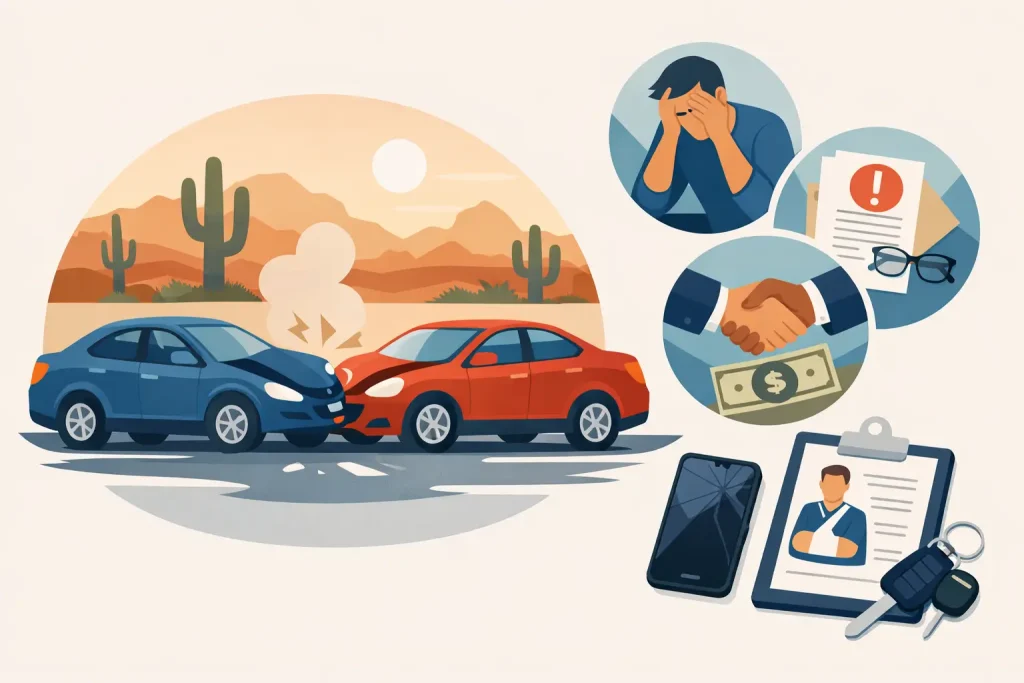
A crash on Highway 89, I-40, or a quiet Prescott Valley intersection can leave you shaken, hurt, and unsure what to do next. In those first hours and days, the top mistakes after a car accident often happen because people are trying to be polite, get home, or trust that the insurance company will handle things fairly. Unfortunately, a few innocent decisions can put both your health and your claim at risk.
You do not need to have every answer at the crash scene. You do need to protect yourself, get appropriate medical care, and avoid giving away information or rights before you understand the full situation.
Mistakes at the Crash Scene
1. Leaving without calling law enforcement
If anyone is injured, there is a dispute about what happened, a driver appears impaired, or the damage is significant, call 911. A police report can preserve critical details before memories change: the location, road conditions, witness names, visible damage, and each driver’s initial account.
Arizona crashes may occur on rural roads where there are few cameras and no nearby businesses. In those cases, the responding officer’s observations and a complete report can become especially valuable. If police do not respond to a minor collision, exchange information and document the scene thoroughly yourself.
2. Apologizing or admitting fault
It is natural to say, “I’m sorry,” after a frightening event. But the other driver’s insurer may later portray a simple expression of concern as an admission that you caused the crash. Avoid guessing about speed, saying you “didn’t see” the other vehicle, or accepting blame before the facts are known.
Stick to the basics when speaking with police and other drivers. Describe what you saw, where you were traveling, and what happened immediately before impact. Let the evidence determine fault.
3. Failing to collect evidence before it disappears
Vehicles are towed, skid marks fade, weather changes, and witnesses leave. If you can do so safely, take photos and video of the vehicle positions, damage, license plates, traffic signals, debris, injuries, weather, and the surrounding roadway. Get names and contact information from witnesses, even if they say they already spoke with an officer.
Save damaged personal property, including a helmet, child car seat, or torn clothing. Do not repair or dispose of your vehicle until it has been photographed and, when necessary, inspected. Evidence can show the force and mechanics of a collision in ways that words alone cannot.
Mistakes That Can Harm Your Health
4. Refusing medical care because you feel “okay”
Adrenaline can hide pain. Whiplash, concussions, back injuries, internal injuries, and soft-tissue damage may not fully appear until hours or days later. Declining an ambulance does not mean you have given up a claim, but it does mean you should pay close attention to symptoms and seek prompt evaluation if pain, dizziness, headaches, numbness, confusion, or stiffness develops.
Follow the treatment plan you receive. That does not mean agreeing to unnecessary care. It means taking your symptoms seriously and giving your providers an accurate picture of how the collision has affected your work, sleep, mobility, and daily life.
5. Waiting too long to see a doctor
A gap in treatment gives an insurance company room to argue that you were not truly hurt or that something else caused your condition. Prompt medical care protects your well-being first. It also creates a record connecting your injuries to the crash.
The right timing depends on your symptoms. Emergency care is appropriate for urgent warning signs. For less severe but persistent pain, schedule an appointment with a qualified medical provider as soon as reasonably possible. Do not minimize your symptoms just because you do not want to inconvenience anyone.
6. Ignoring mental and emotional effects
Not every crash injury appears on an X-ray. Anxiety, nightmares, fear of driving, depression, and difficulty concentrating can follow a serious collision. These consequences are real, particularly after a violent impact or when children were in the vehicle.
Tell your doctor about emotional symptoms as well as physical ones. Keep a private journal of pain levels, missed activities, sleep problems, and how the injury affects family responsibilities. Honest, contemporaneous notes can help you communicate the true impact of the crash later.
Mistakes When Insurance Companies Call
7. Giving a recorded statement too soon
The other driver’s insurance adjuster may sound friendly and say they only need a quick statement to move the claim forward. Their job, however, is to limit what the company pays. A recorded statement given while you are medicated, distressed, or still learning the extent of your injuries can be used against you.
You can provide basic identifying and crash information without speculating about fault or minimizing injuries. Before agreeing to a recorded statement or signing any authorization, consider speaking with a personal injury attorney. Your own insurer may also request cooperation, but you should still answer carefully and truthfully.
8. Accepting the first settlement offer
Early settlement offers often arrive before you know whether you will need follow-up care, physical therapy, diagnostic testing, surgery, or time away from work. Once you sign a release, you generally cannot return for more money if your injury turns out to be more serious than it first appeared.
A fair evaluation considers more than the repair bill. Depending on the case, it may include medical expenses, future treatment needs, lost income, reduced earning capacity, pain and suffering, and the effect on your everyday life. The value depends on the evidence, available insurance coverage, the seriousness of the injury, and who was at fault.
9. Signing broad medical releases
An insurer may ask for access to your medical records, but a broad authorization can give it permission to search through years of unrelated private health information. The company may use preexisting conditions to argue that your current pain is unrelated to the wreck, even when the crash made an existing condition worse.
Medical history can matter in an injury claim, so hiding relevant information is never the answer. The better approach is to provide information that is relevant and necessary while protecting your privacy from an unlimited fishing expedition.
Mistakes That Quietly Weaken a Claim
10. Posting about the crash on social media
A photo of you at a family barbecue, a check-in at a hiking trail, or a casual comment that you are “doing great” can be taken out of context. Insurance companies and defense lawyers may look at public posts to challenge the severity of your injuries. Even a post made by a friend or relative can create problems.
The safest choice is to pause social media activity while your claim is pending and ask friends and family not to post photos or comments about you, the crash, or your recovery. Do not delete existing posts after a claim begins without legal guidance, because removing evidence can create a separate issue.
What to Do Instead
After you are safe, focus on a few practical priorities: report the crash, preserve evidence, obtain appropriate medical care, notify your insurer, and keep records. Save receipts, medical bills, pharmacy costs, repair estimates, towing paperwork, work-loss documentation, and all messages from insurers. Write down every claim number and the name of each adjuster who contacts you.
Arizona injury claims also have deadlines. Waiting can make it harder to locate witnesses, obtain video footage, inspect vehicles, and build the evidence needed to hold a negligent driver accountable. The deadline may be different when a government entity or employee is involved, so do not assume you have plenty of time.
If another driver’s carelessness has left you injured, you should not have to battle an insurance company while trying to heal. Mingus Mountain Law Group offers free claim evaluations for injured people and families across Northern Arizona, with no attorney fee unless there is a recovery. A timely conversation can give you clear next steps before a simple mistake becomes an obstacle to the compensation you need.