
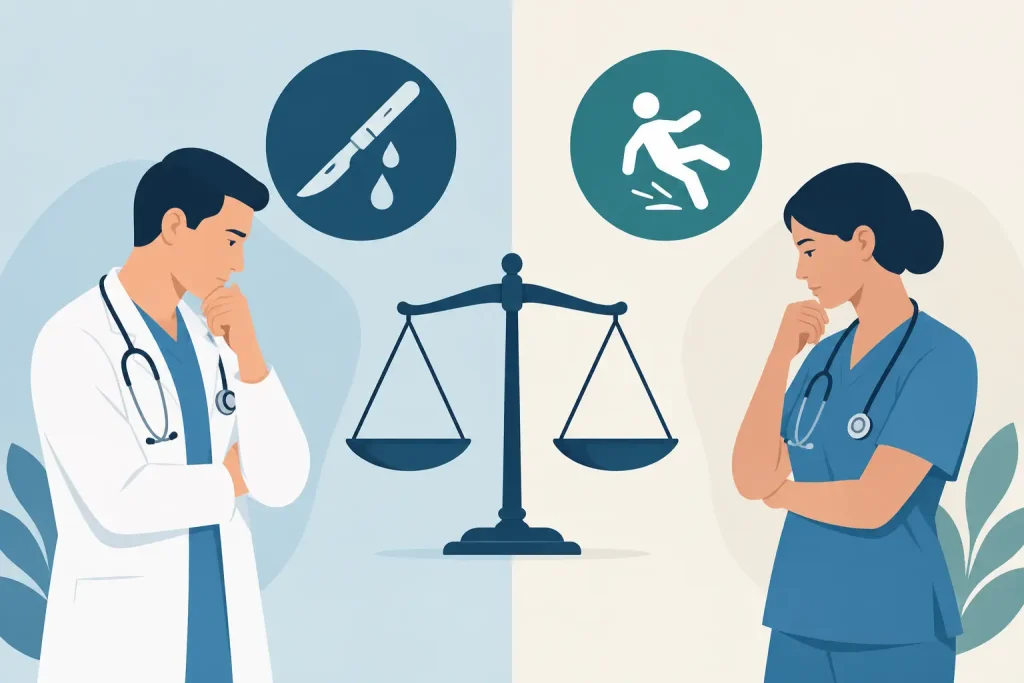
A bad outcome can turn a family’s life upside down. But a painful injury, failed treatment, or financial loss does not automatically mean someone has a legal claim. Understanding malpractice versus negligence helps explain why some cases require proof of a professional failure while others focus on everyday carelessness.
The difference matters because it affects the evidence needed, the experts who may be involved, the deadlines that apply, and the strategy required to pursue full compensation. If you or someone you love was harmed in Northern Arizona, the first question is not what to call the case. It is whether another person or business failed to act with reasonable care and caused real harm.
Negligence Is the Broader Legal Concept
Negligence happens when a person or organization fails to use the level of reasonable care the situation calls for, and that failure injures someone else. It is the legal foundation for many personal injury claims.
A driver who looks at a phone instead of watching traffic may be negligent. A property owner who ignores a broken stairway or an unrestrained dog may be negligent. A trucking company that allows an unqualified driver behind the wheel may also be negligent. The facts differ, but the central issue remains the same: did someone fail to take reasonable steps to prevent foreseeable harm?
Most negligence claims require proof of four connected points. The at-fault party had a duty to act reasonably, breached that duty, caused the injury, and left the victim with damages. Damages can include medical bills, lost income, reduced earning ability, pain and suffering, emotional distress, and the practical losses that follow a serious injury.
That may sound straightforward, but insurance companies often challenge one or more of those points. They may argue the injured person caused the crash, the hazard was obvious, the injuries were preexisting, or the treatment was unnecessary. Strong claims are built with evidence, not assumptions. Photos, incident reports, witness statements, medical records, video footage, and documentation of missed work can all matter.
How Malpractice Differs From Ordinary Negligence
Malpractice is a type of negligence involving a professional who fails to meet the accepted standard of care for that profession. Medical malpractice is the example most people recognize, but malpractice can arise in other professional relationships as well.
In a medical malpractice claim, the question is usually not whether a provider made a mistake in the ordinary sense. Medicine involves risk, judgment calls, and outcomes no provider can guarantee. The question is whether a reasonably careful provider with similar training, working under similar circumstances, would have acted differently.
For example, a poor surgical result is not automatically malpractice. But a claim may exist if a surgeon operated on the wrong body part, failed to respond to clear signs of a complication, or performed a procedure in a way that fell below accepted medical standards and caused injury. Likewise, a delayed diagnosis may support a case when a competent provider should have recognized warning signs and earlier treatment would likely have changed the outcome.
The distinction protects patients from careless care while recognizing that healthcare professionals are not guarantors of recovery. A serious diagnosis, a complication, or even a patient’s death can occur without malpractice. The legal issue depends on what happened, what should have happened, and whether the failure caused additional harm.
Malpractice Versus Negligence: The Key Proof Difference
The biggest practical difference in malpractice versus negligence cases is the standard used to judge conduct.
In an ordinary negligence case, jurors can often use common sense to decide whether conduct was unreasonable. Most people understand why speeding through a red light, leaving a spill in a busy store aisle, or allowing a dog to roam freely can create danger.
Malpractice claims are usually more technical. A jury generally needs help understanding what a qualified doctor, nurse, therapist, attorney, or other professional should have done. That often means testimony from a properly qualified expert who can explain the professional standard of care, how it was breached, and how that breach caused the patient’s injuries.
Causation is frequently the battleground. A defense attorney may admit that care was less than ideal but argue that the patient would have suffered the same outcome anyway. In a delayed cancer diagnosis case, for instance, the question may be whether the delay reduced treatment options, increased the need for aggressive treatment, or affected the patient’s chance of survival. Those issues require a careful review of records and credible expert analysis.
Examples That Show the Difference
A distracted driver rear-ends a stopped vehicle in Prescott Valley and causes a spinal injury. That is generally an ordinary negligence claim. The driver had a duty to operate the vehicle safely, failed to do so, and caused harm.
A hospital nurse administers the wrong medication because they failed to follow required verification procedures, and the patient suffers a severe reaction. That may be medical malpractice because the alleged failure occurred in the delivery of professional healthcare.
A grocery store employee mops an entryway, leaves no warning sign, and a customer falls. The claim is likely premises liability based on ordinary negligence. If the customer receives poor emergency-room care after the fall, there could potentially be a separate medical malpractice claim as well.
Sometimes more than one party bears responsibility. A truck crash may involve a negligent driver, a trucking company that ignored safety rules, a maintenance contractor, and another motorist. A patient injury may involve an individual provider, a medical practice, or a facility. Identifying every responsible party is essential because each may carry different insurance coverage and defenses.
Why the Label Matters to Your Claim
Calling a case malpractice or negligence is not just legal terminology. It changes how the case must be investigated and presented.
Medical malpractice cases commonly involve large volumes of records, complex timelines, expert reviews, and aggressive defense strategies. Hospitals and insurers may have substantial resources devoted to minimizing or denying claims. Early statements, incomplete records, and assumptions about what happened can damage a case before an injured patient has answers.
Ordinary negligence claims can also become complicated quickly. A car insurer may dispute fault. A property owner may claim it had no notice of a dangerous condition. A dog owner may say the victim provoked the animal. The law and available insurance coverage depend on the circumstances, which is why a prompt investigation is often critical.
Arizona also has legal deadlines for filing injury claims, and special rules can apply when a government entity may be involved. Waiting too long can put a valid claim at risk. It is wise to get legal advice early, before evidence disappears or an insurance adjuster pressures you to accept a settlement that does not reflect the full cost of your injuries.
What Injured People Should Do Next
Your health comes first. Follow through with recommended medical care, keep records of appointments and expenses, and pay attention to symptoms that interfere with work, sleep, mobility, or family life. Those details can show the true impact of an injury far better than a medical bill alone.
Avoid assuming an insurer is gathering evidence for your benefit. Insurance companies evaluate claims through the lens of their financial interests. They may seek a quick recorded statement, request broad medical authorizations, or offer money before the long-term consequences of an injury are clear. You have the right to understand your options before making decisions that affect your future.
A thorough case review can determine whether the facts point to ordinary negligence, professional malpractice, or both. It can also identify the evidence needed to hold the right people accountable and pursue compensation that reflects the full harm done.
Mingus Mountain Law Group, PLLC helps injured people and families across Northern Arizona take that next step with clear answers and determined advocacy. A free claim evaluation can provide the guidance you need to protect your rights, focus on healing, and decide what justice should look like for your family.